

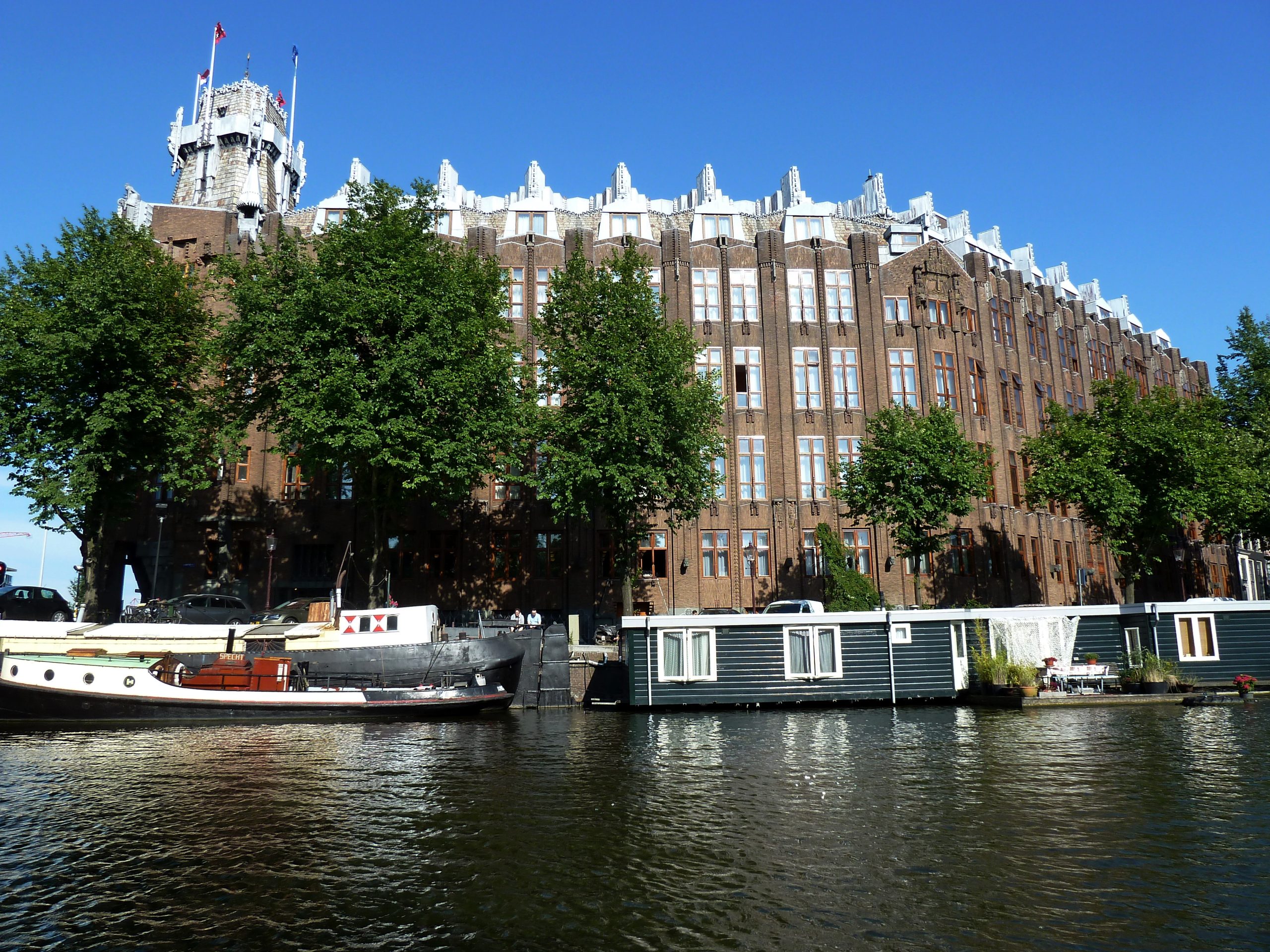
Amsterdam, like London, once was mainly constructed of wooden buildings. And of course at one time in its history it also experienced a Great Fire. So, just like any healthy folk, the ruling governors somewhere in the 15th century passed an ordinance stipulating that all new buildings in the city be constructed of brick walls and ceramic roof tiles. Bazinga!
Today, the upshot of this ordinance is that you see various designs and architectural styles that hint of Renaissance and art deco design but which is characteristically in its own right.
To clarify this statement – the Renaissance style is evident in the stepped gable facades of Amsterdam’s many row houses. And the art deco is everything else that’s stylistically different from your average Georgian building.
But what makes a building typically of the Amsterdam School are the various editions of tightly cemented, mostly red, bricks, often applied in all manner of twists and shapes by rather skilled masons. Many buildings outside the historic city centre of Amsterdam subscribe to the creed of the Amsterdam School architects. They sport round shapes, turrets, so-called ladder windows similar to the Jugendstil style and, equally Jugendstilian, various black or dark green wrought iron bits and bobs. The Rivierenbuurt, where Amsterdam Apartments has a fair few rentals, is the best example of a district dominated by this architecture.
As a tourist you have two options to enjoy what’s become known as the Amsterdam School of architecture, which was officially established in the beginning of the 20th Century by the renowned architect Eduard Cuypers.
-You can take a guided tour through the city. Alternatively you can buy this tour at one of the many VVVs (tourist information offices in the city).
-You can visit Het Schip (the Ship), a museum housed in one of the most typical of Amsterdam School apartments in Amsterdam, located at the Spaarndammerplantsoen. Once this museum housed 120 low rent apartments which were designed in 1911-1920 by the architect Michel de Klerk. Now the museum’s permanent exhibition shows the history and the finest examples of the unique style.
Whichever option you choose, both offer you an off the beaten tourist track experience as you will see often extensively renovated housing estates which do not in any way resemble the downtrodden estates you see in the UK. The exhibition in the museum is well documented in all the European languages plus Japanese and could be a must for architecture lovers.
The museum is located around ten minutes by bus from the Central Station. Take buss 22 (get help finding the stop because they’ve really tucked it away in front of the Victoria Hotel on the canal side of the street, I am told) and it’s the last stop (Zaanstraat). The museum is open Wednesday through to Sunday from 1 pm to 5 pm and by appointment.


